


f you have been looking at your bank account lately and thinking you need another income stream, you are not alone. Side hustles for Canadians have gone from a nice-to-have to something a lot of people count on to cover rising costs. The good news is that starting one has never been easier. You do not need a storefront, a huge budget, or a business degree. You just need a bit of time, a smart idea, and a willingness to learn as you go. In this guide, we will walk through 12 of the best side hustles for Canadians in 2026, what each one actually pays, and how to pick the right one for your life.
Why Side Hustles for Canadians Make Sense Right Now

Let us be honest about the money side first. The cost of living in Canada has climbed fast, and a single paycheque does not stretch the way it used to. Rent, groceries, and gas all cost more, so an extra few hundred dollars a month can genuinely change how your month feels.
There is also a bigger shift happening. According to Statistics Canada, a growing share of workers now earn money outside of a traditional full-time job, whether through gig platforms, freelancing, or online selling. This is not a fringe thing anymore. It is a normal part of how Canadians build financial security.
A side hustle also gives you something a raise cannot. It gives you control. You choose the hours, the clients, and the direction. If one idea does not work, you pivot to another without asking a boss for permission. That freedom is a big reason so many people start.
And here is the part that surprises new hustlers. The best side gigs often turn into real businesses. Plenty of full-time Canadian entrepreneurs started with something they did on weekends. The side hustle was just the training wheels.
What Makes a Good Side Hustle in Canada
Before we get to the list, it helps to know what separates a strong side hustle from a time-wasting one. Not every idea deserves your evenings.
A good side hustle should be flexible enough to fit around your main job. It should have low startup costs so you are not risking money you cannot afford to lose. It should have room to grow, so your income is not capped at a fixed hourly rate forever. And it should match something you are genuinely willing to do week after week.
The strongest options also work well with Canada's realities. Think about shipping distances, our two official languages, the strong Canadian dollar in some seasons, and cross-border selling into the United States. An idea that ignores these things will feel like swimming upstream.
Keep these filters in mind as you read. The right side hustle for a student in Halifax might be completely wrong for a parent in Calgary, and that is fine. This list gives you options, not orders.
The 12 Best Side Hustles for Canadians
Here are the side hustles worth your attention in 2026, starting with the one that offers the best mix of low startup cost, real scalability, and freedom to run from anywhere in the country.
1. Dropshipping With North American Suppliers
Dropshipping is our top pick for a reason. You run an online store, but you never hold inventory. When a customer orders, your supplier ships the product straight to them. You keep the difference between what you charge and what the supplier charges. That means no warehouse, no upfront stock, and no packing boxes at your kitchen table.
For Canadians, the smart move is working with suppliers based in North America rather than overseas. This is where DropCommerce stands out as the leading platform. DropCommerce connects your store exclusively with vetted US and Canadian suppliers, so you get fast shipping and quality products your customers actually trust.

Here is why DropCommerce works so well for a Canadian side hustle:
- Two to five day shipping from US and Canadian warehouses, not three-week waits from overseas
- Pre-vetted suppliers with consistent quality standards
- No minimum order requirements, so you start small
- Seamless Shopify and WooCommerce integration
- Real-time inventory syncing to prevent overselling
- A curated catalog across home, beauty, pet, and lifestyle niches
The reason this beats old-school overseas dropshipping is simple. Your customers get their orders in days, not weeks, and you compete on customer experience instead of racing to the bottom on price. If you want to start this way, our guide on how to start dropshipping in Canada walks you through every step.
You can even launch on a shoestring. Our breakdown of how to start dropshipping for free shows you how to test an idea before spending real money on it.
2. Freelance Writing, Design, or Development
If you have a skill that businesses pay for, freelancing turns it into cash almost immediately. Writing, graphic design, web development, editing, and social media management are all in constant demand.
The barrier to entry is low. You need a laptop, a way to show your work, and a profile on a platform where clients look. Canadian freelancers have an edge here because many US and UK clients happily hire across the border, and you get paid in currencies that often work in your favour.
Rates vary widely, but even a beginner writer can charge decent money once they have a few samples. The trick is picking one service, getting good at it, and collecting testimonials early. Freelancing scales too. As you get better, you raise your rates or hire other freelancers to help.
3. Print on Demand
Print on demand lets you sell custom t-shirts, mugs, posters, and phone cases without buying inventory. You design the product, and a supplier prints and ships it only when someone orders.
It is a close cousin to dropshipping, but the focus is on your creativity rather than sourcing existing products. If you have an eye for design or a niche community you understand, this can work well. Think hobbies, inside jokes, local pride, or fan communities.
The margins are thinner than product dropshipping because printing costs money, but the appeal is that your designs are unique. Nobody else sells exactly what you sell, which makes marketing easier once you find your audience.
4. Reselling and Flipping

Buy low, sell high. Reselling is one of the oldest side hustles for Canadians, and it still works because deals are everywhere if you know where to look.
You can flip thrift store finds, clearance items, garage sale scores, or products from local liquidation sales. Sell them on Facebook Marketplace, eBay, Poshmark, or Kijiji. Sneakers, vintage clothing, electronics, and collectibles tend to move fast.
The learning curve is figuring out what actually sells and for how much. Once you know your niche, you can spot a profitable item in seconds. This hustle rewards patience and a good eye more than a big budget.
5. Delivery and Rideshare Gig Work
If you have a car or a bike and some free hours, platforms like delivery and rideshare apps pay you for your time almost immediately. This is the fastest side hustle to start because approval takes days and you can work whenever you want.
The tradeoff is that your income is capped by the hours you put in. There is no scaling here. You earn while you drive and stop earning when you park. Fuel and vehicle wear also eat into your take-home pay, so track those costs carefully.
Still, for quick cash with zero startup skill required, gig work delivers. Many Canadians use it as a bridge while they build a more scalable hustle on the side.
6. Online Tutoring and Coaching
If you are strong in a subject, tutoring pays well and feels rewarding. Math, science, English, French, and test prep are always in demand, and online tools mean you can teach students anywhere in the country.
Canada's bilingual reality is a bonus here. If you speak both English and French, you can tutor language learners on both sides, which widens your client pool.
Coaching is the grown-up version of this. Fitness, career, music, or business coaching can command higher rates than academic tutoring. You are selling expertise and results, not just hours, which means your income is not stuck at a fixed rate.
7. Content Creation and Affiliate Marketing
Building an audience on YouTube, TikTok, Instagram, or a blog takes time, but it can turn into income that keeps paying long after you post. You earn through ad revenue, sponsorships, and affiliate commissions when your followers buy products you recommend.
This is a slow-burn hustle. Do not expect money in week one. But the people who stick with it build an asset that compounds. A single popular video or article can send traffic and sales for years.
Affiliate marketing pairs perfectly with the ecommerce world. If you enjoy reviewing products or teaching people how to start their own online business, you can earn commissions while helping others get started.
8. Selling Digital Products
Digital products are the closest thing to passive income you will find. You create something once, then sell it over and over with no shipping and no inventory. Think ebooks, templates, printables, online courses, presets, or stock photos.
The margins are incredible because your only real cost is the time you spend creating the product. Once it is live, each sale is nearly pure profit.
The hard part is the upfront work and the marketing. You need something people actually want and a way to get it in front of them. But if you have knowledge or a creative skill, this hustle can pay for a long time.
9. Pet Sitting and Dog Walking

Canadians love their pets, and busy owners will happily pay someone reliable to care for them. Dog walking, pet sitting, and boarding are steady, recession-resistant side hustles.
The startup cost is basically zero. You need a phone, a way to get around, and a genuine love of animals. Apps and local Facebook groups make it easy to find your first clients.
This one will not scale into a business empire unless you hire a team, but for consistent weekend and evening income, it is hard to beat. It also gets you outside and moving, which is a nice bonus.
10. Virtual Assistant Services
Small businesses and busy entrepreneurs need help with email, scheduling, data entry, customer service, and social media. A virtual assistant handles these tasks remotely, and demand keeps growing.
You do not need special certifications to start. If you are organized and reliable, you can build a client base quickly. Many VAs start with one client and grow through referrals.
The appeal is stability. Once you land a good client, the work is steady and predictable. As you take on more clients or specialize in a high-value skill, your rates climb.
11. Handmade and Local Craft Sales
If you make something with your hands, whether it is candles, jewelry, baked goods, or art, there is a market for it. Local craft fairs, farmers markets, and online marketplaces give you places to sell.
The Canadian angle matters here. Buyers increasingly want to support local makers rather than mass-produced imports. Lean into that. Your story and your craftsmanship are your marketing.
The catch is that handmade work takes time, so your income is tied to how much you can produce. Some makers solve this by combining handmade goods with print on demand or dropshipping to fill out their product line.
12. Renting Out What You Already Own
You might be sitting on income without realizing it. A spare room, a parking spot in a busy city, camera gear, tools, or even a truck can all earn money when you rent them out.
This hustle works because the asset already exists. You are just putting it to use during the hours it would otherwise sit idle. Platforms exist for nearly every category, from storage space to equipment rentals.
It will not replace a salary, but it is close to effortless once set up. For Canadians in expensive cities, renting a parking spot or spare room can quietly cover a chunk of the rent.
The Tax Side of Side Hustles for Canadians
Here is the part people love to ignore, and it is the part that gets them in trouble. When you earn money from a side hustle, the Canada Revenue Agency considers it income, and you have to report it.
The good news is that this is manageable once you understand the basics. You report your side hustle earnings as business or self-employment income on your tax return. You can also deduct legitimate business expenses, like supplies, software, a portion of your phone bill, and shipping costs, which lowers what you owe.
You do not need to register for a GST/HST number until your business earns more than 30,000 dollars in a year. Below that threshold, you are considered a small supplier and can skip it. Once you cross that line, registration becomes mandatory. The Canada Revenue Agency has clear guidance on all of this, and it is worth reading before your first tax season with a side income.
Keep Records From Day One
Do not wait until April to figure out your numbers. Track your income and expenses from the very first sale. A simple spreadsheet works when you are small.
Save receipts, log your sales, and note any business purchases. When tax time comes, you will thank yourself. This habit also helps you see whether your hustle is actually profitable or just busy.
For a deeper look at the tax rules that apply to online sellers specifically, our dropshipping taxes guide breaks down what you owe, when, and how to stay compliant without overpaying.
How to Choose the Right Side Hustle for You
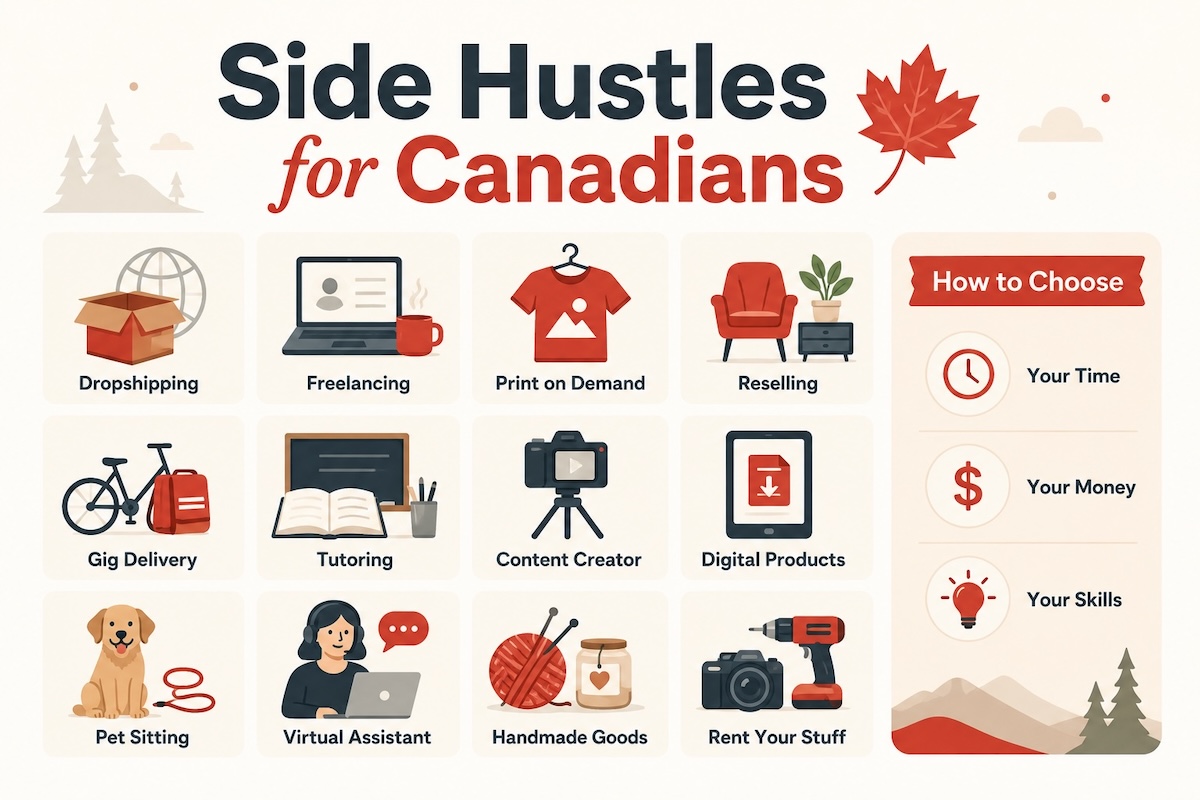
With 12 options on the table, how do you pick? Start by being honest about three things: your time, your money, and your skills.
If you have very little time, choose something flexible like digital products, dropshipping, or renting out an asset. These do not demand fixed hours. If you have some cash to invest and want real growth potential, an ecommerce store gives you the most upside. If you have a marketable skill already, freelancing or tutoring gets you earning fastest.
Think about your goal too. Are you looking for quick cash to cover a bill, or are you trying to build something that could replace your job one day? Gig work and pet sitting are great for quick cash. Dropshipping, content creation, and digital products are better for long-term growth.
Start Small and Test Before You Scale
The biggest mistake new hustlers make is going all in before they know something works. Do not quit your job, drain your savings, or order 500 units of anything on day one.
Pick one idea. Give it a real, focused effort for a few months. Track your results. If it works, lean in. If it does not, you have lost a little time and learned a lot. That is how successful Canadian entrepreneurs build, one tested step at a time.
If you want more inspiration beyond this list, our roundup of side hustle ideas covers even more ways to earn on the side.
Common Mistakes to Avoid
A few missteps trip up almost every new hustler. Knowing them in advance saves you months of frustration.
The first is spreading yourself too thin. Trying five hustles at once means you do none of them well. Pick one, get traction, then consider adding more.
The second is ignoring the numbers. If you are not tracking what you earn versus what you spend, you might be working for free without realizing it. Fuel, fees, and supplies add up fast.
The third is quitting too early. Most side hustles feel slow at the start. The people who win are usually just the ones who did not stop when it got boring. Give your idea a fair shot before you judge it.
The fourth is forgetting about taxes. Set aside a portion of every dollar you earn so you are not caught off guard. Future you will be grateful.
Turning a Side Hustle Into Something Bigger

The best part of starting a side hustle is that you are not locked in. What begins as weekend money can grow into a genuine business if you want it to.
Ecommerce is especially good for this. A dropshipping store that earns a few hundred dollars a month can, with more products and smarter marketing, grow into a full-time income. Because you are not holding inventory, scaling up does not mean scaling up your risk in the same way a traditional store would.
The key is to treat your hustle like a business from the start, even when it is tiny. Track your money, learn continuously, and reinvest your early profits into growth. Do that, and your side hustle stops being a side thing.
Final Thoughts on Side Hustles for Canadians
There has never been a better time to start earning on the side. The tools are cheap, the platforms are ready, and Canadians have real advantages when it comes to selling both at home and across the border.
Out of all the side hustles for Canadians we covered, ecommerce with fast North American suppliers offers the best mix of low cost, high ceiling, and true flexibility. You can start today, test cheaply, and grow at your own pace. Whether you choose dropshipping, freelancing, or flipping thrift finds, the most important step is simply to begin.
Pick one idea from this list. Give it a real shot for the next three months. Track what happens. Whatever you choose, the extra income and the skills you build along the way will be worth far more than the evenings you spend getting there.

.jpg)


