


f you're trying to start an ecommerce business, you've almost certainly hit the same fork in the road: should you dropship, or should you buy wholesale? The dropshipping vs wholesale debate is one of the first big decisions you'll make, and it shapes nearly everything that follows, from how much money you need to start to how much profit you keep.
Here's the honest truth. Neither model is universally "better." They're different tools for different situations. Dropshipping wins on low risk and easy startup. Wholesale wins on margins and control. The right choice depends on your budget, your goals, and how much risk you can stomach.
In this guide, we'll break down the dropshipping vs wholesale decision across seven key differences, show you the real pros and cons of each, and help you figure out which model actually fits your situation in 2026.
Dropshipping vs Wholesale: The Quick Answer
Before we dig into details, here's the short version for people who want it now.
Dropshipping means you sell products without holding any inventory. When a customer orders, your supplier ships the product directly to them. You never touch the product, and you only pay for it after you've made a sale.
Wholesale means you buy products in bulk at a discount, store them yourself, and ship them to customers when they order. You own the inventory, which means more upfront cost and risk, but also more control and bigger margins per sale.
So the dropshipping vs wholesale tradeoff comes down to this: dropshipping trades profit and control for low risk and convenience, while wholesale trades higher risk and effort for better margins and ownership. Now let's see exactly how they compare.
It's worth noting that both models sit inside a booming ecommerce market. Global retail ecommerce sales are projected to climb well into the trillions over the coming years, which means there's room for both fulfillment models to thrive. The growth of online shopping isn't the constraint. Your choice is really about how you want to operate within that growth, not whether the opportunity exists.
What Is Dropshipping?
Dropshipping is a retail fulfillment model where you don't keep the products you sell in stock. Instead, you partner with a supplier who holds the inventory and ships orders on your behalf.
The flow is simple. A customer buys from your online store at retail price. You forward that order to your supplier and pay the wholesale price. The supplier ships the product directly to your customer. You keep the difference as profit, and you never had to buy inventory upfront.
This is why dropshipping has such a low barrier to entry. You can launch a store with a small budget, test products without committing cash to stock, and run the whole thing from a laptop. The tradeoff is thinner margins and less control over shipping and quality, since you're relying on your supplier for both.
What Is Wholesale?
Wholesale is the more traditional retail model. You buy products in large quantities directly from a manufacturer or distributor at a discounted per-unit price, then resell them to customers at a markup.
Because you're buying in bulk, your cost per unit drops significantly. That's the core advantage. When you own the inventory, you also control storage, packaging, shipping speed, and quality. You can inspect products before they reach customers and build a more consistent brand experience.
The catch is obvious: you need real money upfront to buy that inventory, plus somewhere to store it. You also carry the risk that products won't sell, leaving you with cash tied up in boxes in your garage. Wholesale rewards planning and capital, and punishes guessing.
The 7 Key Differences in Dropshipping vs Wholesale
Now for the head-to-head. Here are the seven differences that matter most when weighing dropshipping vs wholesale.
1. Startup Costs
This is the biggest practical difference for most beginners. Dropshipping has very low startup costs because you don't buy inventory upfront. Realistic startup costs for a dropshipping store run from $200 to $3,000, mostly for your website, apps, and ad testing budget.
Wholesale demands far more capital. Beyond your store and marketing, you need enough money to place a meaningful bulk order, which can easily run into the thousands before you've made a single sale. If you're starting lean, dropshipping is the clear winner here.
2. Inventory and Storage
With dropshipping, you hold zero inventory. Your supplier stores everything, which means no warehouse, no garage full of boxes, and no inventory management headaches.
Wholesale flips this completely. You buy and store products yourself, so you need storage space and a system to track stock, fulfill orders, and reorder before you run out. This is real work, and it's a cost many beginners underestimate when comparing the two models.
3. Profit Margins
Here's where wholesale shines. Because you buy in bulk at deep discounts, your per-unit margins are usually much higher. It's common for wholesale margins to land in the 50% range or more, depending on the product.
Dropshipping margins are tighter, typically in the 15% to 30% range, because you pay a higher per-unit price to your supplier for the convenience of not holding stock. If maximizing dropshipping profit margins is your top concern, wholesale has a structural edge. But remember, higher margins mean nothing if the inventory doesn't sell.
4. Risk Level
Dropshipping is low risk by design. You only pay for products after a customer has paid you, so you're never stuck with unsold stock. If a product flops, you simply stop selling it and move on. Nothing lost but time.
Wholesale carries real financial risk. You commit cash to inventory before you know whether it'll sell. Pick wrong, and you're sitting on products you can't move. This is the single biggest reason cautious beginners lean toward dropshipping when weighing the two models.
5. Control Over Quality and Shipping
Wholesale gives you control. You hold the product, so you can inspect quality, package it your way, include branded inserts, and choose your own shipping speed. That control makes it easier to build a premium, consistent brand.
Dropshipping hands much of that control to your supplier. Shipping times, packaging, and quality depend on them, which is why supplier choice matters enormously. Using vetted, fast suppliers, especially domestic dropshipping partners with 2 to 5 day shipping, closes most of this gap and removes the most common dropshipping complaint.
6. Scalability
Dropshipping scales easily because growth doesn't require more physical work from you. Ten orders or ten thousand, your supplier handles fulfillment either way. You can scale by spending more on marketing without touching a single box.
Wholesale scaling is more involved. More sales means more inventory to buy, store, and ship, which can mean hiring help or renting warehouse space. It scales, but it scales with friction and capital, not just ad spend.
7. Branding Potential
Wholesale makes branding easier because you control the physical product and packaging. Custom inserts, branded boxes, and quality control all build a memorable brand experience that's hard to replicate when you never touch the product.
Dropshipping branding is possible but harder, since your supplier ships generic packaging in most cases. That said, options like blind shipping and private-label dropshipping suppliers narrow this gap, and plenty of dropshipping stores build strong brands through their marketing, content, and customer experience instead.
Dropshipping vs Wholesale: Side by Side
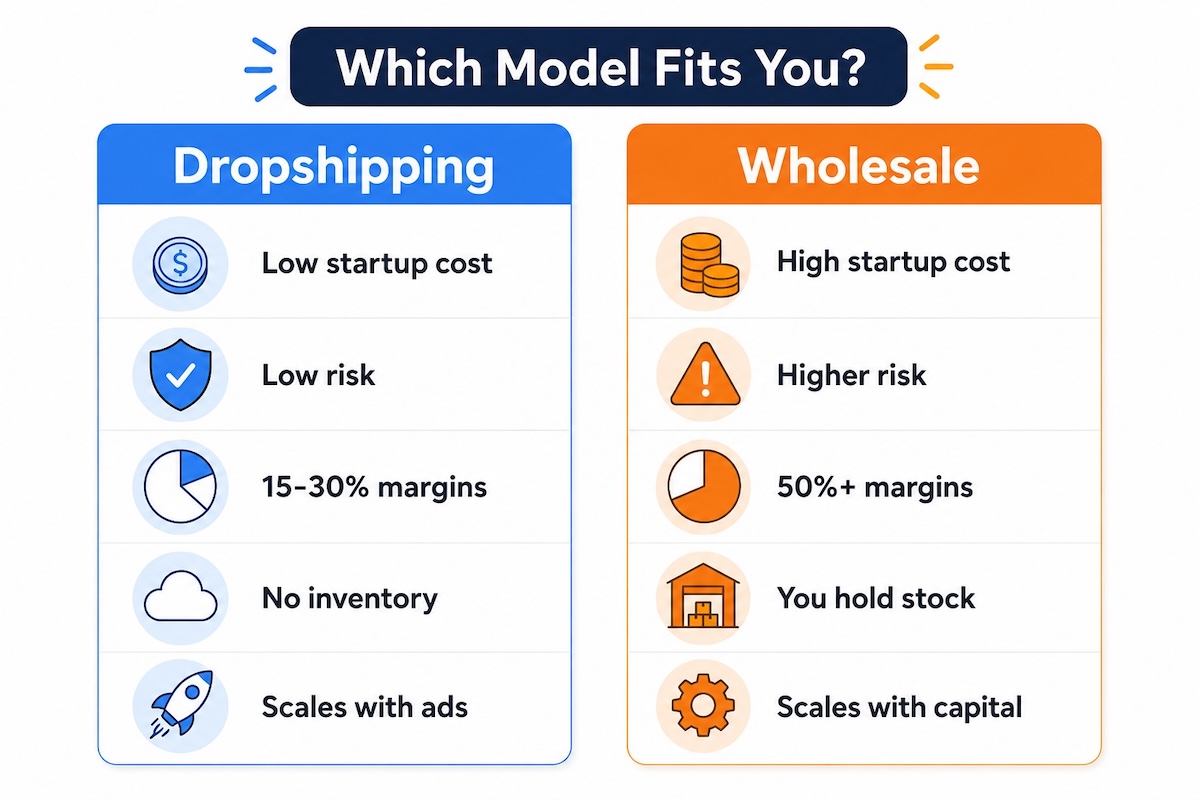
Let's summarize the comparison in plain terms.
Startup cost: Dropshipping is low ($200 to $3,000). Wholesale is high (often several thousand in inventory alone).
Inventory risk: Dropshipping carries almost none. Wholesale carries significant risk of unsold stock.
Profit margins: Dropshipping runs 15% to 30%. Wholesale often reaches 50% or more.
Control: Dropshipping gives limited control. Wholesale gives full control over quality and shipping.
Effort to start: Dropshipping is fast and easy. Wholesale requires capital, storage, and planning.
Scalability: Dropshipping scales with marketing. Wholesale scales with capital and logistics.
Seen this way, the dropshipping vs wholesale choice isn't about which is better overall. It's about which set of tradeoffs fits where you are right now.
Which Model Is Right for You?
Let's make this practical. The best choice depends on your specific situation, not on which model sounds more impressive.
Choose dropshipping if...
Dropshipping is the better fit if you're starting with a limited budget, you want to test products before committing money, or you value flexibility and low risk over maximum margins. It's ideal for beginners, side-hustlers, and anyone who wants to validate demand before investing heavily. If you're not sure whether an idea will sell, dropshipping lets you find out cheaply.
It's also a strong choice if you'd rather compete on marketing and customer experience than on warehousing and logistics.
Choose wholesale if...
Wholesale makes sense if you have capital to invest, you've already validated that a product sells, and you want the higher margins and control that come with owning inventory. It suits established sellers, brands with proven demand, and people who can handle storage and fulfillment.
If you've been dropshipping a product successfully and demand is consistent, moving it to wholesale can dramatically boost your margins. This is a common and smart progression.
Why not both?
Here's a strategy many successful sellers use: start with dropshipping to test and validate products cheaply, then transition your proven winners to wholesale to capture better margins. This hybrid approach captures the best of both models. You get low-risk testing up front and high-margin ownership once you know what works. The dropshipping vs wholesale decision doesn't have to be permanent or all-or-nothing.
A Real-World Example: The Same Product, Two Models
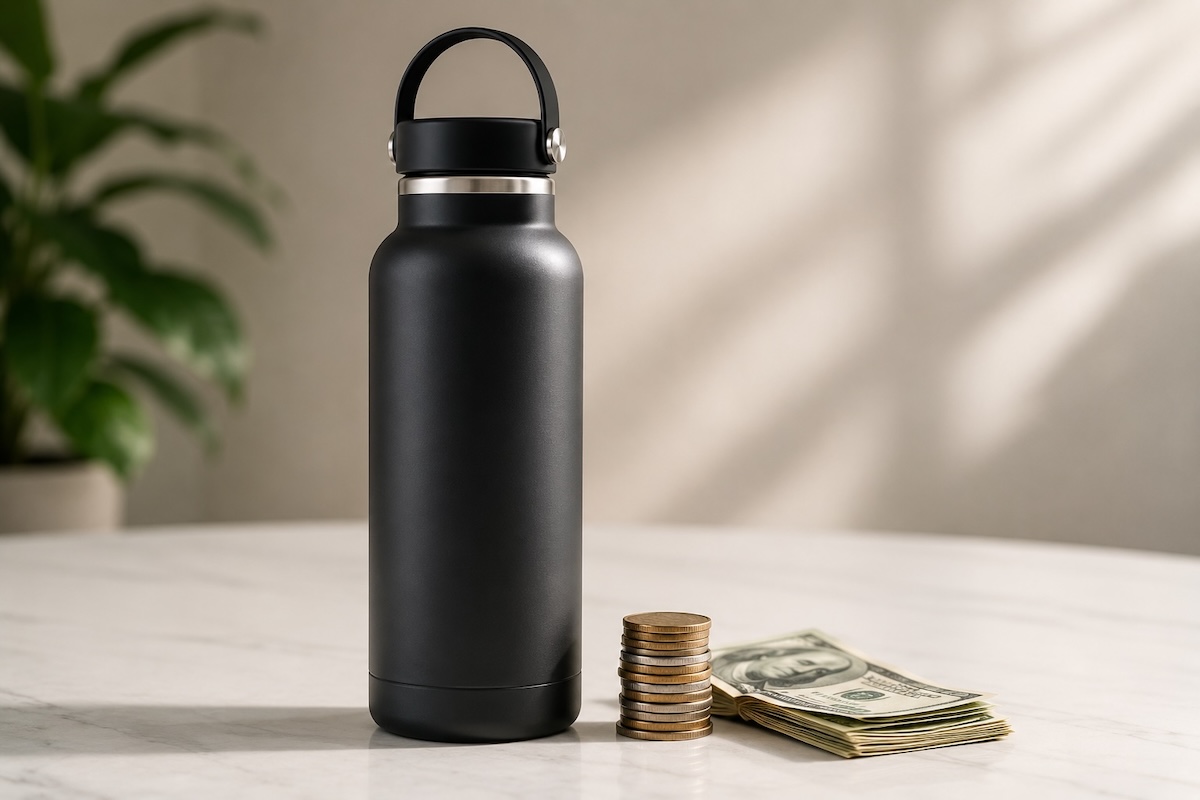
Numbers make this concrete, so let's walk through a simple example using a single product: a $40 retail water bottle.
Under dropshipping, your supplier charges you roughly $28 per unit and ships it for you. You sell at $40, so you keep about $12 before ad costs and fees. You invested nothing in inventory, you carry no risk, and if the bottle doesn't sell, you've lost nothing but the ad spend you used to test it.
Under wholesale, you buy 200 bottles at $16 each, spending $3,200 upfront. You sell each at $40, keeping $24 per unit before storage, shipping, and fees. That's double the per-unit profit. But you had to risk $3,200, and you have to store and ship those 200 bottles yourself. If only 80 of them sell, that "better margin" suddenly looks a lot less comfortable.
This is the dropshipping vs wholesale tradeoff in a single product. Wholesale earns more per sale but only if the product moves. Dropshipping earns less per sale but never leaves you holding the bag. Your tolerance for that upfront risk is often the deciding factor.
How the Two Models Affect Your Daily Workload
People focus on money in this comparison and forget about time. The day-to-day reality of each model is very different, and it's worth picturing before you commit.
A typical dropshipping day

With dropshipping, your daily work is mostly marketing and customer service. You're writing ads, creating content, answering questions, and forwarding orders to suppliers, which is often automated. You spend almost no time on physical fulfillment, which frees you to focus on growth. This is why dropshipping appeals to people who want a location-independent, laptop-based business.
A typical wholesale day
With wholesale, fulfillment is part of your routine. You're managing stock levels, packing boxes, printing labels, coordinating shipments, and reordering inventory before it runs out. There's more operational work, and it grows as you grow. Some sellers love this hands-on control. Others find it becomes a grind that limits how far they can scale without hiring help.
Neither workload is "better," but they attract different kinds of people. Be honest about which one you'd actually enjoy, because you'll be living it every day.
Common Mistakes to Avoid With Either Model
Whichever side of the dropshipping vs wholesale line you land on, a few mistakes trip people up regardless of model.
First, don't skip product validation. Wholesale buyers who skip it get stuck with dead stock, and dropshippers who skip it waste ad budget. Test demand before you bet big.
Second, don't ignore supplier quality. In dropshipping, a bad supplier ruins your reputation through slow shipping and defects. In wholesale, a bad supplier leaves you with unsellable inventory. Vet suppliers carefully in both cases.
Third, don't underestimate marketing. Neither model sells itself. Whether you dropship or buy wholesale, you still need traffic, a compelling offer, and a store people trust. The fulfillment model is only half the business. The other half is getting customers, and that work is the same either way.
How to Transition From Dropshipping to Wholesale
Since the hybrid path is so popular, it's worth knowing how the move actually works. Many of the most profitable stores start lean and graduate winning products to wholesale once the data justifies it.
The trigger is consistency. When a product sells steadily for a few months and you're confident demand is real, the math starts favoring a bulk buy. You're no longer guessing whether it'll sell, which removes wholesale's biggest risk.
Start small with your first wholesale order rather than going all in. Buy enough to test the margins and logistics without overcommitting. Calculate your true landed cost per unit, including shipping and storage, and confirm the improved margin is worth the added work. Choosing the right dropshipping niche early makes this transition smoother, because a focused catalog gives you clear winners to scale instead of a scattered pile of random products.
Done right, this progression lets you keep the low-risk testing engine of dropshipping running while steadily building a higher-margin wholesale core underneath it. That's the best of both worlds, and it's why the dropshipping vs wholesale question is often answered with "both, in sequence."
Final Thoughts: There's No Universal Winner
The dropshipping vs wholesale debate has no single right answer, and anyone who tells you otherwise is selling something. Both models build real, profitable businesses every day. The question is which one fits your budget, your risk tolerance, and your goals today.
If you're starting out, short on capital, or testing ideas, dropshipping's low risk and easy entry are hard to beat. If you've got capital and proven demand, wholesale's margins and control are the reward for taking on more risk. And if you're smart, you might use both: dropship to discover winners, then go wholesale to maximize them.
Whichever path you choose, success comes down to the same fundamentals: pick products people want, source from reliable suppliers, and market relentlessly. Get those right, and either model can take you exactly where you want to go. The model you start with isn't a life sentence either, so choose the one that fits today and adjust as your business and your bank account grow.

.jpg)


