


f you're running a store in 2026, you already know the game has changed. The winning products aren't found by luck anymore. They're found by volume, and specifically by video volume. That's exactly why the best AI video tools for dropshipping 2026 has become one of the most searched topics among serious store owners. The stores pulling profitable returns on TikTok, Reels, and Snapchat are the ones shipping dozens of ad variants a week, and no human editor can keep up with that pace alone. This guide ranks the nine tools actually worth your time, explains how dropshippers use them, and shows where they fit in a real workflow.
Why AI Video Is the New Dropshipping Superpower
Let's start with the "why" before the "which." Understanding the shift makes the tool choices obvious.
A few years ago, you could win with one good product ad and a decent budget. Not anymore. The platforms reward volume because their algorithms need variety to find a winner, and your audience burns through creative fast. A dozen decent video variants will usually beat three polished ones, because the algorithm gets more chances to find the hook that clicks.
Here's the economics that make AI unavoidable. Filmed UGC (user-generated content) from a real creator costs roughly $150 to $300 per video and takes days to deliver. An AI-generated variant costs closer to $1 and lands in minutes. When you need 20 to 30 variants per product to test properly, the math isn't close. This is the single biggest reason AI video tools exploded across dropshipping in 2026. Short-form video now dominates social feeds, with platforms like TikTok reporting that native, authentic video drives the strongest engagement and purchase intent.
Volume Beats Perfection
The mindset shift matters more than any tool. Stop chasing one perfect ad. Start shipping many good ones and let the data pick the winner. AI video lets a solo store owner produce the creative volume that used to require a whole team, which is the real unlock.
What Makes a Great AI Video Tool for Dropshipping
Not every AI video generator fits an ecommerce workflow. Some are built for filmmakers, not marketers. Here's what actually matters when you're picking tools for product ads.
Look for fast batch output, since testing means making many versions quickly. Prioritize UGC-style realism, because lo-fi authentic video outperforms glossy commercials on TikTok and Reels. Vertical 9:16 format is non-negotiable for the feeds that matter. Bonus points for tools that take a product URL or supplier image and turn it into a finished ad with minimal prompting.
Match the Tool to the Job
No single tool wins at everything. Some excel at realistic spokesperson ads, others at cinematic B-roll, others at sheer speed. The smartest store owners stack two or three tools rather than forcing one to do it all. Keep that in mind as we go through the list.
The Best AI Video Tools for Dropshipping 2026
Here's the ranked list. We've weighted these toward what dropshippers actually need: speed, UGC realism, vertical format, and cost per variant.
1. Higgsfield
Higgsfield leads the pack for dropshippers because it's built around volume and product ads, not just pretty clips. Its Marketing Studio can turn a single product concept into UGC-style, CGI, or cinematic ad variations from one prompt, and its UGC Builder produces the authentic, lo-fi feel that performs on TikTok. You can generate multiple creative directions in one session, which is precisely the workflow ad testing demands.
What makes it stand out is the model-hub approach. Higgsfield gives you access to several top video models under one roof, so you're not locked into a single look. For a store owner who needs to ship many hooks fast and cheaply, it's the most complete starting point in 2026.
2. Arcads
Arcads is the specialist pick for AI UGC ads and paid social testing. It shines at realistic spokesperson hooks, those 15 to 30 second clips where an avatar looks into the camera and sells the product like a real creator would. The output sits within genuine UGC variance, meaning it doesn't scream "AI" the way weaker tools do.
If your strategy leans on testimonial-style and hook-driven ads for Meta and TikTok, Arcads belongs on your shortlist. It costs more than budget options, but the realism often justifies it for DTC stores.
3. Kling

Kling is the value champion. At a low monthly price, it delivers strong quality that makes it a favorite for UGC creators, faceless content channels, and marketers who need to iterate on ad variations rapidly. When your whole strategy depends on producing many versions, keeping per-variant cost low is a real advantage.
For beginners watching their budget, Kling is one of the easiest ways to start producing serious volume without draining your ad account.
4. Google Veo 3.1
If you want the strongest all-around cinematic quality, Veo 3.1 (accessed through Google Flow) is the benchmark. It's less about spokesperson UGC and more about beautiful product B-roll, lifestyle scenes, and hero shots that make a cheap product look premium.
Use Veo when you need that scroll-stopping visual moment. Pair it with a UGC tool for the talking-head hooks, and you've got a complete ad.
5. Runway Gen-4.5
Runway is the pick for creators who want tight control over their output. It's a favorite for ads and client-style deliverables where you need to direct the scene, not just accept whatever the model gives you. The learning curve is a bit steeper, but the payoff is precision.
For stores building a more polished brand look, Runway offers the creative control that pure text-to-video tools lack.
6. Shhots AI

Shhots AI is built for pure speed. Feed it a supplier product URL and it ships a finished ad in about two minutes, with no prompting or editing required. For dropshippers who want the absolute fastest path from product to testable ad, this end-to-end approach is hard to beat.
It won't give you the fine control of Runway, but that's not the point. When you need 30 variants live by tomorrow, tools like this earn their place.
7. Hedra
Hedra focuses on realistic character and avatar performance, making it a solid companion to Arcads for spokesperson-style content. Its output holds up within real UGC variance, so your AI creator ads feel human enough to convert.
If you're building a library of talking-head hooks and want a second option for variety, Hedra rounds out the roster nicely.
8. Creatify
Creatify is designed specifically for ecommerce and product testing. It leans into the "test products fast without samples" workflow that so many dropshippers now rely on, generating avatar-driven ads tuned for conversion rather than art.
For store owners who think in terms of CAC and ROAS rather than aesthetics, Creatify speaks your language.
9. ClipLoft
ClipLoft rounds out the list with a batch-first workflow built for UGC-style avatar ads in the 9:16 format that Meta and TikTok consume. Its whole design centers on testing multiple hook variants at once, which is exactly the muscle a modern dropshipping store needs.
It's a strong choice when your bottleneck is simply producing enough vertical variants to feed the algorithm.
A Quick Note on Sora
You'll still see Sora mentioned in older roundups, so it's worth being clear. The Sora web and app experience has been discontinued, and its API is scheduled to wind down in September 2026. Treat it as a legacy benchmark, not a safe pick to build your 2026 workflow around. The tools above are all actively supported and better suited to ecommerce.
How to Use AI Video Tools in a Real Dropshipping Workflow
Owning the tools is easy. Using them to actually make money takes a system. Here's a simple loop that works.
First, pick a product and write three to five different angles or hooks. Second, generate multiple video variants for each angle using a UGC tool like Arcads or Higgsfield, plus a cinematic clip or two from Veo for B-roll. Third, launch them as low-budget tests on TikTok or Meta. Fourth, kill the losers fast and pour budget into the winners. Fifth, repeat weekly. The goal is a steady pipeline, not a one-time home run.
If this sounds like a lot, that's because volume is the point. The stores winning in 2026 treat creative like a testing machine, not a single creative act. Our guide on dropshipping marketing strategies covers how this fits into a broader plan, and if TikTok is your main channel, our TikTok dropshipping breakdown goes deeper.
Don't Forget the AI Beyond Video
Video is just one piece. AI now touches product research, copywriting, and customer service too. If you want the full picture of where automation helps, our roundup of AI tools for dropshipping is a natural next read after this one.
The Piece AI Video Can't Fix: Your Shipping

Here's the trap nobody warns you about. Great AI video can send a product viral overnight, but if your supplier takes three weeks to deliver, that viral spike becomes a wave of refund requests, chargebacks, and angry comments that tank your ad account. The creative brings the traffic. Your fulfillment decides whether it turns into a real business.
This is where your supplier choice matters as much as your video tools. In 2026, customers expect fast delivery, and slow overseas shipping is the fastest way to waste the traffic your ads worked so hard to earn.
Why DropCommerce Pairs Perfectly With AI Creative

DropCommerce is built for exactly this moment. It connects your store with pre-vetted US and Canadian suppliers, so the traffic your AI videos generate actually converts into happy, repeat customers instead of disputes.
Here's why it fits a video-first strategy:
- Two to five day shipping from US and Canadian warehouses
- Pre-vetted suppliers with consistent quality standards
- No minimum order requirements, so you can test freely
- Seamless Shopify and WooCommerce integration
- Real-time inventory syncing to prevent overselling during a viral spike
- A curated catalog across home, beauty, pet, and lifestyle niches
DropCommerce works best for store owners who compete on customer experience and brand, not the lowest price. Pair fast domestic fulfillment with a steady stream of AI-generated ads, and you've got a store that both looks and ships like a real brand. If you're weighing local sourcing, our guide on domestic dropshipping explains the full advantage.
Comparing the Tools at a Glance
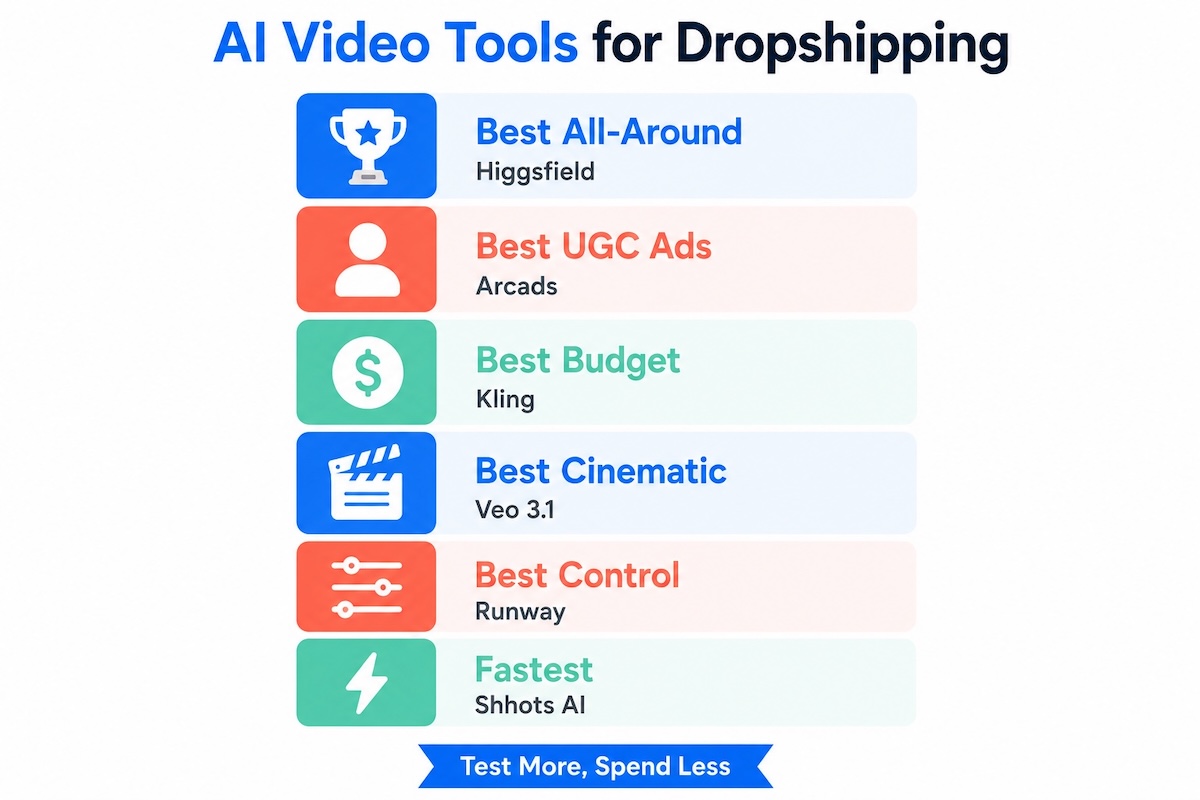
Since our CMS reads better in prose than tables, here's a quick cheat sheet of where each tool fits. Skim this before you commit to a subscription.
Best all-around for product ads: Higgsfield. Its Marketing Studio and UGC Builder cover UGC, CGI, and cinematic from one place, with model-hub flexibility.
Best for realistic spokesperson UGC: Arcads, with Hedra as a strong second option for variety in your talking-head library.
Best budget pick for volume: Kling. Low cost per variant makes it ideal when your whole strategy depends on shipping many versions.
Best cinematic quality: Google Veo 3.1 for hero shots and lifestyle B-roll that make a cheap product look premium.
Best creative control: Runway Gen-4.5 when you want to direct the scene rather than accept whatever the model generates.
Best for pure speed: Shhots AI, which turns a supplier URL into a finished ad in about two minutes.
Best for ecommerce testing workflows: Creatify and ClipLoft, both built around batch-testing avatar ads in vertical format.
Budgeting for Your Creative Stack
Most store owners land on a stack of two or three tools rather than one. A common beginner setup is Kling for cheap volume plus one specialist like Arcads for polished hooks. As you scale and find winners, you can layer in Veo for premium B-roll. The good news is that even a full stack usually costs less than a single week of filmed UGC, so your creative budget stretches much further than it did just a couple of years ago. Reinvest what you save into ad spend and product testing.
Common Mistakes to Avoid With AI Video Ads
AI video is powerful, but it's easy to misuse. Here are the traps that quietly kill results, so you can skip them.
The biggest mistake is chasing perfection instead of volume. Spending three days perfecting one ad defeats the entire purpose. Ship many good variants and let data decide. According to marketing research summarized by HubSpot, short-form video consistently delivers the highest return on investment of any content format, but only when brands publish consistently rather than sporadically.
The second mistake is making ads that look too much like ads. Over-produced, glossy videos underperform the lo-fi, authentic style that feels native to the feed. Lean into imperfection on purpose.
Test the Right Way
A third trap is testing too many variables at once. Change one thing at a time, usually the hook, so you actually learn what's working. And never scale a winning ad before your fulfillment can handle the volume, which brings us to the point most guides skip entirely.
Frequently Asked Questions
New store owners tend to ask the same things when they start exploring AI video. Here are quick, honest answers.
Which AI video tool is best for beginners?
Start with Kling if budget is tight, or Higgsfield if you want the most complete all-in-one starting point. Both let you produce real volume without a steep learning curve. You can always add specialist tools like Arcads later once you know what converts for your niche.
Are AI video ads allowed on TikTok and Meta?
Yes, AI-generated ads run on both platforms, and UGC-style AI video often outperforms polished traditional ads. The key is authenticity. Lo-fi, natural-feeling clips convert better than obvious, over-produced ones. Follow each platform's disclosure rules for AI content and you're fine.
How many video variants should I test per product?
Aim for 15 to 25 fresh vertical variants per week across your active products. That volume gives the algorithm enough to find winners before your audience fatigues. This is exactly the workload AI video tools are built to handle cheaply.
Do AI video tools replace real UGC creators?
Not entirely, but they change the math. For fast, cheap testing at volume, AI wins easily. Once you find a winning product, some stores still commission a few premium human UGC videos for their best-performing angles. Think of AI as your testing engine and human UGC as an occasional finisher.
Final Takeaway on the Best AI Video Tools for Dropshipping 2026
The best AI video tools for dropshipping 2026 all point to the same truth: winning now means producing creative at a volume that only AI makes affordable. Higgsfield leads for all-around product ad production, Arcads and Hedra own realistic UGC hooks, Kling wins on budget, and Veo and Runway handle the cinematic polish. Stack two or three based on your niche and start testing.
Just remember that the flashiest ad in the world can't save a store with slow shipping. Pair your AI creative pipeline with fast, reliable domestic fulfillment through DropCommerce, and you'll turn all those viral views into a business that actually lasts. Stop obsessing over one perfect ad, start shipping volume, and make sure your fulfillment can keep up with the demand you create.

.jpg)


