


very store gets return requests eventually. A mug shows up cracked, a sweater runs small, or someone just changes their mind. When that happens, your refund policy is the rulebook both you and your customer will lean on. This guide gives you a complete dropshipping refund policy template you can copy, fill in, and publish today, along with an explanation of every section so you know why it is there.
Here is the twist that makes dropshipping different. You do not hold the inventory, so you do not control where returns go or how fast a refund gets approved upstream. Your supplier does. A good policy has to work for your customers and stay in line with what your suppliers will actually accept. We will cover both sides, step by step.
Why Dropshippers Need a Clear Refund Policy
A refund policy is not just legal fine print. It is a sales tool. Shoppers who are on the fence often check the return terms before they buy, especially from a store they have never heard of. Clear, fair terms tell them you are a real business that stands behind its products.
A clear policy also saves you time. When the rules are written down, you are not inventing a new answer for every email. You can point to the policy, apply it the same way every time, and avoid arguments. That consistency matters even more as your order volume grows.
The Dropshipping Twist: Two Sets of Rules
In a regular store, the owner sets the return rules and receives the returned item. In dropshipping, there are two sets of rules in play: the promises you make to your customer and the terms your supplier offers you. If those two do not match, you end up paying the difference.
For example, say you promise a 60 day return window, but your supplier only accepts returns within 30 days. A customer who returns an item on day 45 gets a refund from you, and you get nothing back from the supplier. That gap is where profit quietly leaks out. If you want a broader look at how returns flow between you, your customer, and your supplier, our guide to dropshipping returns and refunds walks through the whole process.
What Every Dropshipping Refund Policy Template Must Cover
Before you copy anything, it helps to know what each section does. These ten parts show up in almost every solid policy. Skip one, and you leave a gap that customers will find for you.
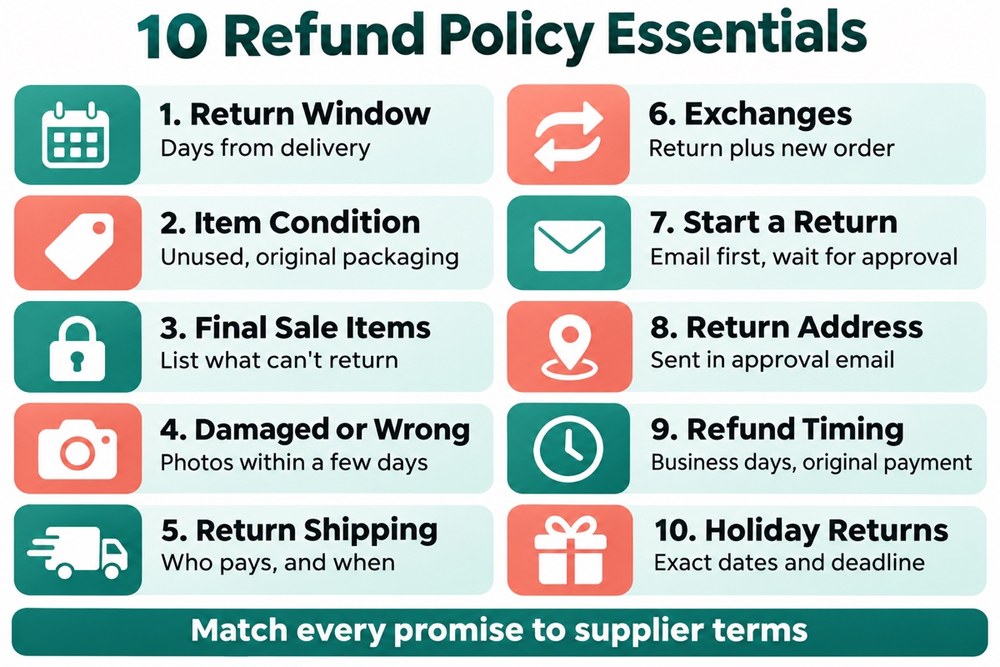
1. The Return Window
This is the number of days a customer has to request a return. Most stores count from the delivery date, not the order date, because shipping times can vary. Be specific. "30 days from delivery" is clear. "A reasonable time" is not.
Pick a window your suppliers can support. If you are not sure, start with the shortest window among your main suppliers and build from there.
2. Item Condition Requirements
State what shape an item needs to be in to qualify. Common rules include unused, unwashed, with original tags, and in the original packaging. This protects you from paying full refunds on items that cannot be resold.
Keep it fair, though. If someone has to open a box to know a product does not fit, punishing them for opening it will feel harsh. Focus on whether the item is still in sellable condition.
3. Non-Returnable Items
Some products cannot be returned for hygiene, safety, or practical reasons. Typical examples include opened beauty and personal care items, intimate apparel, food, custom or personalized products, and gift cards. List these clearly so nobody is surprised.
Check your supplier terms here too. If a supplier marks a category as final sale, your policy should say the same thing for those products.
4. Damaged, Defective, or Wrong Items
This section matters most because it covers mistakes that are not the customer's fault. Ask customers to contact you within a short window, often a few days after delivery, and to include clear photos of the item, the damage, and the shipping box.

Those photos are not just for you. Many suppliers need photo proof before they will credit you or send a replacement. Asking for them up front speeds up the claim and keeps the customer from waiting while you chase details. In these cases, you should cover all costs, including any return shipping.
5. Who Pays Return Shipping
Be direct about who covers the cost of sending an item back. A common setup is that the store pays for damaged, defective, or wrong items, while the customer pays for change-of-mind returns.
Free returns can raise conversion, but they also cost real money on every return. Run the numbers on your typical order value and margin before you promise them. Our breakdown of dropshipping profit margins can help you see how much room you actually have.
6. Exchanges
Explain whether you offer exchanges for a different size or color. In dropshipping, an exchange is often simpler to handle as a return plus a new order, since the new item ships from the supplier. Say that plainly so customers know what to expect.
If a replacement depends on stock, mention that too. A short line like "exchanges depend on availability" saves you from promising a size that is sold out.
7. How to Start a Return
Give customers a simple, step-by-step process. Usually it looks like this: email support with the order number, wait for approval and instructions, then ship the item using the details you provide. Make one rule very clear: do not send anything back without approval first.
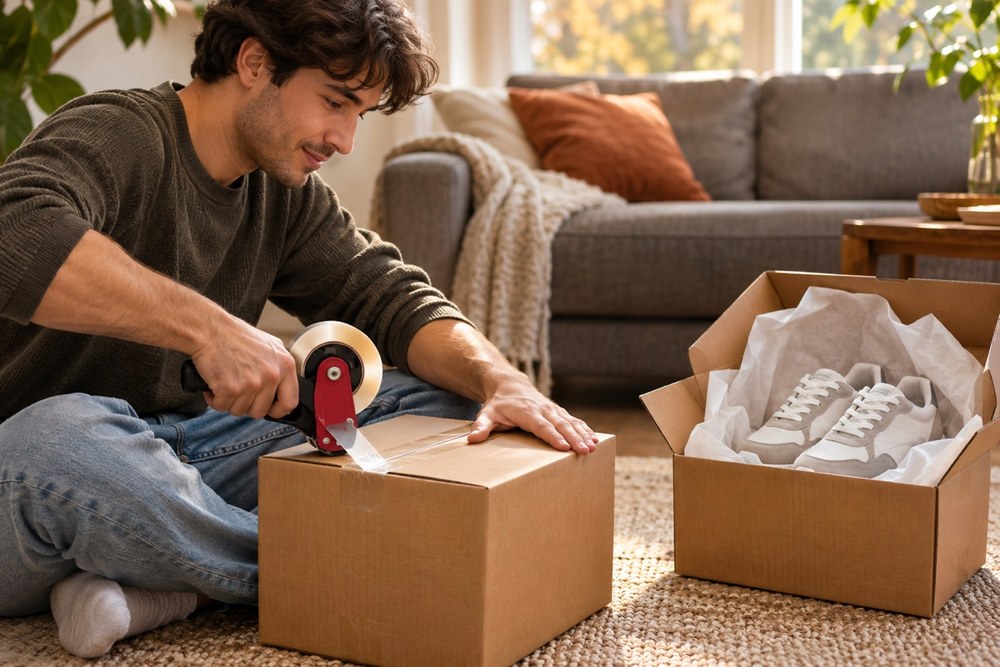
That approval step protects you. It lets you confirm the item qualifies and get the correct return address from your supplier before anything is shipped.
8. Where Returns Go
This is the part many new dropshippers get wrong. Your return address is usually your supplier's warehouse, not your home, and it can be different for each supplier. Never print a single fixed return address in your policy unless every product really goes back to that one place.
Instead, say that you will send the return address with the approval email. That keeps your policy accurate even when you work with several suppliers.
9. Refund Timing and Method
Tell customers how long a refund takes once the return arrives. Explain that the refund goes back to the original payment method and that their bank may need a few extra business days to post it. Also say whether original shipping charges are refunded.
Only promise timing you can meet. If your supplier needs a few days to inspect a return before crediting you, build that into the number you share.
10. Holiday Extended Returns
Many stores extend their return window for holiday orders so gift buyers can shop early with confidence. A common approach is to let purchases made during a set holiday period be returned until a fixed date in January.
If you offer this, state the exact purchase dates and the final return date. Then confirm your suppliers will honor returns that late. If they will not, you are covering those refunds yourself.
How to Align Your Policy With Supplier Return Terms
Your policy is only as strong as the supplier terms behind it. Before you publish, gather the return terms for every supplier you sell from. Look for their return window, condition rules, final sale categories, damage claim deadlines, photo requirements, and where returns get shipped.

Next, find the strictest rules across your suppliers and use those as your baseline. If one supplier gives 14 days and another gives 30, either use the shorter window for everything or note different windows for different product groups. A single simple rule is usually easier for customers to follow.
Plan for the Gaps
Sometimes you will want to be more generous than your supplier. That is fine, as long as it is a choice and not an accident. For low-cost items, it can be cheaper to issue a refund and let the customer keep the product than to pay for return shipping. Decide on a dollar limit for these "keep it" refunds ahead of time.
Write down how each supplier handles claims too. Who do you email, what proof do they need, and how fast do they respond? Having this on hand turns a stressful return into a quick routine.
Know Supplier Terms Before You List Products
The easiest time to check return terms is before a product ever goes live. When you source through a platform like DropCommerce, you are working with vetted suppliers, which makes it easier to ask questions and understand terms up front. Either way, read each supplier's return terms before importing products, and ask directly if anything is unclear.
Your Copy-Paste Dropshipping Refund Policy Template
Below is a full policy you can copy into your store. Replace everything in [BRACKETS] with your own details, delete any section that does not apply, and make sure every number matches your supplier terms. Read it out loud once you are done. If any line sounds confusing, rewrite it.
Refund and Return Policy for [STORE NAME]
Thank you for shopping with [STORE NAME]. We want you to love your order. If something is not right, this policy explains how returns, exchanges, and refunds work. This policy was last updated on [DATE].
Return Window
You can request a return within [NUMBER] days of the date your order was delivered. Requests made after this window may not be accepted.
Item Condition
To be eligible for a return, items must be unused, in the same condition you received them, and in the original packaging with any tags attached. [ADD ANY EXTRA CONDITION RULES HERE.]
Items That Cannot Be Returned
The following items are final sale and cannot be returned unless they arrive damaged, defective, or incorrect:
- [CATEGORY, FOR EXAMPLE OPENED BEAUTY OR PERSONAL CARE ITEMS]
- [CATEGORY, FOR EXAMPLE PERSONALIZED OR CUSTOM PRODUCTS]
- Gift cards
- [ANY OTHER FINAL SALE ITEMS]
Damaged, Defective, or Incorrect Items
If your order arrives damaged, defective, or is not what you ordered, please email us at [SUPPORT EMAIL] within [NUMBER] days of delivery. Include your order number and clear photos of the item, the problem, and the shipping box. We will review your request and offer a replacement or a full refund, including any return shipping costs.
Return Shipping Costs
For damaged, defective, or incorrect items, we cover return shipping. For all other returns, [the customer is responsible for return shipping costs / we provide a prepaid return label / we deduct a return shipping fee of [AMOUNT] from your refund]. Original shipping charges are [refunded / not refunded].
Exchanges
If you need a different size or color, please request a return for the original item and place a new order for the item you want. Exchanges depend on product availability.
How to Start a Return
- Email [SUPPORT EMAIL] with your order number and the reason for your return.
- Wait for our reply with approval and return instructions.
- Pack the item securely and ship it to the address we provide.
- Send us the tracking number for your return shipment.
Please do not send items back before your return is approved. Items sent without approval may not be accepted.
Where Returns Are Sent
Our products ship from partner warehouses, so the return address can vary by item. We will send the correct return address with your approval email. Please do not send returns to [ANY ADDRESS SHOWN ON PACKAGING OR WEBSITE].
Refunds
Once your return is received and inspected, we will email you to confirm whether your refund is approved. Approved refunds go back to your original payment method within [NUMBER] business days. Your bank or card provider may need extra time to post the refund to your account.
Holiday Returns
Orders placed between [START DATE] and [END DATE] can be returned until [FINAL RETURN DATE]. All other return rules in this policy still apply.
Contact Us
Questions about returns or refunds? Email us at [SUPPORT EMAIL] or [OTHER CONTACT METHOD]. We aim to reply within [NUMBER] business days.
A Quick Note on Legal Requirements
This article and template are not legal advice. Consumer protection rules depend on where you sell, and some countries give online shoppers rights that go further than a store policy. Check the consumer laws in each region you sell to, and talk to a qualified professional if you are unsure.
If you sell to US customers, it is worth reading the FTC's Business Guide to the Mail, Internet, or Telephone Order Merchandise Rule. That rule focuses on shipping and cancellations rather than returns. You need a reasonable basis for any shipping time you state, or for shipping within 30 days if you state none. If you cannot ship on time, you must give the buyer the option to cancel. Refunds for cancelled orders paid by card through a third party, such as a regular credit card, must go out within seven working days.
Where to Put Your Policy on Your Store
A policy only helps if customers can find it. Link it in your store footer, mention it on product pages, and include it in your order confirmation emails. Some stores also add a short line near the add-to-cart button, like "30 day returns," to ease buying worries.
If you use Shopify, you can add your policy from your admin under Settings, then Policies. Shopify's help page on adding store policies explains that once your policies are added, they are linked in the footer of your checkout pages automatically. Shopify also offers its own automated policy option, but you should still compare its wording against your dropshipping refund policy template and your supplier terms before you rely on it.
Train Your Support Replies Too
Your policy and your support replies should say the same thing. Write a few saved responses for common cases, like damage claims, change-of-mind returns, and late requests. Our guide to dropshipping customer service covers how to keep replies fast and friendly, even when the answer is no.
Common Refund Policy Mistakes to Avoid
Even a good template can go wrong if you fill it in carelessly. Watch out for these common slip-ups:
- Promising a longer return window than your suppliers allow
- Listing your home address as the return address
- Forgetting to ask for photos on damage claims
- Using vague phrases like "a reasonable time" instead of real numbers
- Leaving the policy unchanged after you add a new supplier
The last one is easy to miss. Every new supplier can bring new terms, so make a habit of checking your policy each time you add products from someone new.
Frequently Asked Questions
Here are quick answers to the questions store owners ask most about refund policies.
Do I Legally Need a Refund Policy?
It depends on where you are and where your customers live. Some places have specific rules about returns and cancellations, and others do not. Even where a written policy is not strictly required, having one builds trust and makes disputes easier to handle. Check your local consumer laws to be sure.
Can I Use a Dropshipping Refund Policy Template As Is?
You can use it as a starting point, but you should not publish it without editing. Every bracketed detail needs your real numbers, and those numbers must match your supplier terms. A dropshipping refund policy template saves you time, but it cannot know your suppliers for you.
Should I Offer Free Returns?
Free returns can boost trust and sales, but they cost money on every return. Many stores offer free returns only for damaged or wrong items and charge for change-of-mind returns. Look at your margins before deciding.
What If My Supplier Does Not Accept Returns?
Then you have a choice. You can make those products final sale in your policy, cover returns yourself, or offer a refund without requiring the item back for low-cost products. If a supplier will not handle even damaged items, think hard about whether that product belongs in your store.
How Long Should My Return Window Be?
Thirty days is a common choice, but the right answer is the window your suppliers can support. Starting shorter and extending later is safer than promising too much and absorbing the cost.
Final Thoughts on Your Refund Policy
A strong refund policy turns returns from a headache into a routine. Cover the ten essentials, match every promise to your supplier terms, and write in plain language your customers can understand in a minute. Then put the policy where shoppers will see it, from the footer to the checkout.
Use this dropshipping refund policy template as your foundation, fill in the brackets carefully, and review it whenever your suppliers change. A clear policy protects your margins and gives customers one more reason to trust you.
A refund policy is easiest to write when you know your suppliers' terms before you list a single product. If you want vetted suppliers behind the promises you make to customers, try DropCommerce and build your store on partners you can plan around.


