


ou probably started dropshipping because someone told you it was cheap to launch. And honestly, they were half right. The startup costs can be low. But the hidden costs of dropshipping show up later, and they are the reason so many new stores quietly bleed out before hitting their first profitable month.
Most courses and YouTube videos skip over this part. They hype up the big wins and skip the small charges that stack up behind the scenes. This guide walks you through the real expenses nobody warns you about, so you can plan a budget that actually holds up in practice.
Why These Costs Stay Hidden
Dropshipping looks cheap on the surface because the biggest expense of traditional retail, inventory, is out of the picture. You do not pay for products until customers buy them. That feels like a massive win when you are starting out.
But shifting inventory off your balance sheet does not make costs disappear. It just spreads them across smaller line items that are harder to track. Platform fees, payment processor charges, ad spend, refunds, chargebacks, and app subscriptions all quietly eat into your margins. None of them feel huge on their own. Added together, they are often the difference between profit and loss.
The Margin Math Nobody Talks About
Most dropshipping profit margins sit between fifteen and thirty percent before hidden expenses. After those hidden costs hit, real margins often land closer to five to fifteen percent. That is still workable, but it changes your strategy completely. You need higher order volumes, smarter pricing, and tighter operations to actually make money.
The store owners who ignore these expenses tend to raise ad spend, chase revenue, and assume profits will follow. They do not. Understanding the hidden costs of dropshipping upfront is how you avoid that trap. It lets you price correctly from day one and protect your margins as you scale.
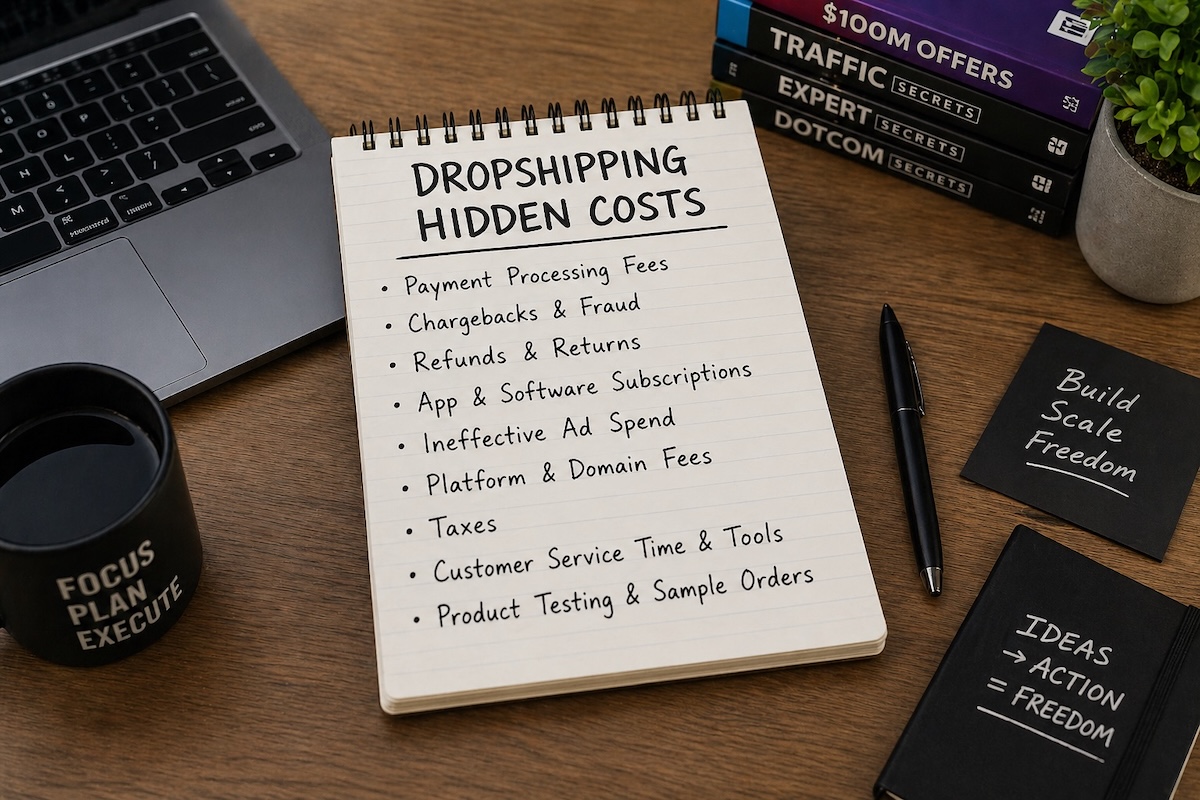
The 9 Hidden Costs Every Dropshipper Faces
Here is a realistic breakdown of what actually comes out of your pocket. These are the quiet expenses that separate stores that last from stores that fold within six months.
1. Payment Processing Fees
Every time a customer checks out, your payment processor takes a cut. Shopify Payments, Stripe, and PayPal typically charge around 2.9 percent plus 30 cents per transaction in the United States. Credit cards issued outside your home country add another 1 to 1.5 percent.
On a $40 order, that is about $1.46 gone before you do anything else. Over a thousand orders per month, that is nearly $1,500 in processing fees alone. Most new store owners forget to build this into their pricing, which means they quietly lose money on every transaction. Always price your products to absorb payment fees without eating into your net margin.
2. Chargebacks And Fraud
Chargebacks are one of the most painful expenses in dropshipping. A customer files a dispute with their bank, you lose the sale, and you usually lose a fee on top of that. Most processors charge $15 to $25 per chargeback, whether you win the dispute or not.
Long shipping times from overseas suppliers are a huge chargeback driver. When a customer waits three weeks for a package, they often assume the order was a scam and dispute the charge. Using domestic dropshipping suppliers with faster shipping is one of the most effective ways to reduce chargeback rates. Faster delivery means fewer disputes, which means more of your revenue actually stays in your account.
3. Refunds And Returns
Returns are a certainty, not a maybe. Industry data suggests that 20 to 30 percent of online orders get returned, though the rate is lower for most dropshipping niches. Either way, you are going to issue refunds, and each one usually comes with a cost.
Most suppliers will not accept returns directly. That means you either eat the cost of the product, pay to ship it back yourself, or offer a partial refund to keep the customer happy. None of these options are free. Budget for refund expenses at around 3 to 8 percent of revenue, depending on your category. Beauty and apparel run higher. Home goods and pet supplies run lower.
4. App And Software Subscriptions
Running a Shopify store without apps is nearly impossible. Email automation, upsell tools, reviews, inventory syncing, analytics, and page builders all cost money. A typical dropshipping store spends $50 to $200 per month on apps alone.
Those subscriptions are easy to forget about because they hit your card automatically. But over a year, $150 per month becomes $1,800. Audit your app stack every quarter. Kill anything you do not actively use. Our guide to the best free Shopify apps is a good starting point if you want to cut subscription costs.
5. Ad Spend That Does Not Convert
This is one of the biggest hidden costs of dropshipping for beginners. When you run Facebook, TikTok, or Google ads, you pay for every click regardless of whether someone buys. Testing new products can eat $500 to $2,000 before you find one that converts.
Even successful campaigns waste money. Click fraud, low-quality traffic, and creative fatigue all add up. Most experienced operators assume 30 to 50 percent of ad spend is burned on non-buyers during testing phases. That is not a bug. That is the price of finding a winner. Budget for it so you do not panic when it happens.
6. Platform And Domain Fees
Your core platform bill goes beyond the obvious monthly fee. Shopify starts at $39 per month for the Basic plan. Then you add transaction fees if you use a processor other than Shopify Payments. Then you add a domain name at around $15 per year. Then email hosting. Then SSL if your platform does not include it.
Most store owners underestimate these line items. They add up to $60 to $150 per month before a single product is listed. Compare platform costs carefully before you commit. Our breakdown of Shopify vs WooCommerce for dropshipping will help you figure out which makes sense for your budget.
7. Taxes You Did Not Expect

Taxes are a quiet expense that surprises almost every new dropshipper. Sales tax nexus rules require you to collect and remit tax in any state where you have a strong business presence. Income taxes apply to your profits at year end. Self-employment tax in the United States adds another 15.3 percent on top of your regular income tax.
Most new store owners forget to set aside money for taxes, which means they end up scrambling at the end of the year. A good rule of thumb is to save 25 to 30 percent of your net profit in a separate account for tax obligations. According to IRS guidance on self-employment, you should also be making quarterly estimated payments once your profit crosses a certain threshold. Missing those triggers penalties on top of the original tax bill.
8. Customer Service Time And Tools
Customer service is free if you do it yourself. But your time is not worth zero. Every hour you spend answering emails, handling complaints, or chasing supplier updates is an hour you are not using to grow the store. At some point, you have to either hire help or pay for automation.
A basic help desk tool runs $20 to $50 per month. A virtual assistant can cost $500 to $1,500 per month, depending on hours and location. Both are legitimate expenses that show up as you scale, and most new operators forget to plan for them. Do not wait until you are drowning in tickets. Build service costs into your pricing before the volume arrives.
9. Product Testing And Sample Orders
Before you promote a product, you should order it yourself. This lets you check quality, shipping time, and packaging. It also gives you real product photos for your store and ads. Each sample costs money, and most store owners test five to ten products before finding a winner.
Sample orders can easily run $100 to $300 per niche. Add shipping, and you might spend $500 before you launch a single ad. This is money well spent because it protects your reputation, but it is another line item most guides leave out. Bake sample costs into your startup budget so you are not surprised when they hit.
Bonus: The Cost Of Your Own Time
Your time is the most underpriced expense in any new business. Most beginners think they are saving money by doing everything themselves. In reality, the hours you spend on tasks that could be automated or outsourced carry a real opportunity cost.
Think about it this way. If you spend ten hours a week on customer service and order management, that is forty hours a month. At even $20 per hour of your time, that is an $800 invisible cost every single month. You do not see it on a bank statement, but it slows down your growth and burns out your energy. Tracking your hours for a few weeks is the fastest way to see which tasks are worth automating or delegating first.
How To Reduce The Hidden Costs of Dropshipping
Once you know where money is leaking, you can plug the holes. Here are the most effective ways to keep these quiet expenses from eating your store alive.
Choose Suppliers With Faster Shipping
Fast shipping fixes more problems than any other single change. Shorter delivery times reduce chargebacks, lower refund rates, cut down on customer service tickets, and improve repeat purchase rates. All of those savings compound quickly.
Overseas suppliers often look cheaper upfront, but the hidden charges usually wipe out the savings. Pre-vetted North American suppliers, like the ones available on DropCommerce, typically ship in two to five days. That kind of reliability reduces the cost of every order you process, even if the per-unit price is a few dollars higher.
Price Products To Absorb Fees
Do not price based on cost plus a round markup. Price based on what actually lands in your bank account after every fee. Build in a buffer of 10 to 15 percent for payment processing, chargebacks, refunds, and occasional discounts. If that cuts too deeply into your desired margin, your price is too low.
This is where a lot of beginners go wrong. They copy competitor pricing without understanding what those competitors have built into their margins. Always run the full math before you publish a product page.
Audit Your Apps Every Quarter
App creep is real. You install apps to solve problems, then forget to remove them when the problem goes away. Every three months, go through your app list and cancel anything you are not using. Most store owners find two or three subscriptions they forgot about.
Swap paid apps for free ones whenever possible. Many of Shopify's built-in tools cover what third-party apps charge for. Start with the features your store plan already includes before adding external tools.
Keep A Tax Reserve From Day One

Open a separate savings account and transfer 25 to 30 percent of your net profit into it every month. You want that money out of sight and out of reach so you are not tempted to spend it. At tax time, the bill will be waiting for you without the panic.
This is one of the simplest habits that separates amateur operators from pros. A good bookkeeper can also help you find deductions you did not know existed, which often pays for their services several times over.
Build A Chargeback Prevention System
Clear product descriptions, accurate delivery estimates, real product photos, and proactive shipping updates all reduce chargebacks. Most disputes happen because customers feel surprised or ignored. A simple tracking email sent three days after an order ships can cut dispute rates by half.
Set up order tracking notifications. Respond to customer messages within 24 hours. Make your refund policy clearly visible. These tiny steps are cheaper than paying $25 per chargeback, and they are also how you build the kind of store customers actually trust.
Track Every Expense In A Simple Spreadsheet
You cannot manage what you cannot see. A basic spreadsheet that logs monthly platform fees, app subscriptions, ad spend, refunds, and chargeback costs will show you exactly where the money is going. Most store owners who do this for the first time are shocked by the total.
Do not overcomplicate the tracking. A simple monthly row with columns for each category is plenty. The goal is to spot trends before they become disasters. If ad spend is climbing but revenue is flat, that shows up immediately. If refund rates are creeping up on a specific product, you can pull that SKU before it drains your account. A fifteen-minute monthly review is one of the best habits you can build.
How DropCommerce Helps You Avoid Hidden Costs

A lot of the hidden costs of dropshipping come from one root problem: cheap overseas suppliers with slow shipping and inconsistent quality. When customers wait three weeks for a package that arrives in damaged generic packaging, you get a cascade of refund requests, chargebacks, and support tickets.
DropCommerce solves that by focusing exclusively on US and Canadian suppliers who ship in two to five days. The catalog is pre-vetted across home, beauty, pet, and lifestyle categories, which means you avoid the quality issues that drive so many expensive disputes. No minimum order requirements let you test products without tying up capital in unproven SKUs.
Fewer Surprises, Cleaner Margins
Real-time inventory syncing prevents the worst customer service nightmare: selling products you do not actually have in stock. Seamless Shopify and WooCommerce integration means orders flow through automatically, which reduces manual errors and saves hours of your time every week. The whole platform is designed for store owners who want predictable operations rather than constant firefighting.
Paired with smart pricing and disciplined app management, North American suppliers are one of the highest-leverage moves you can make to control the hidden costs of dropshipping. Every reduction in delivery time, every improvement in product quality, and every prevented chargeback flows directly to your bottom line. Learn more about the broader cost picture in our guide to how much it costs to start dropshipping.
Final Thoughts On The Hidden Costs of Dropshipping
Dropshipping is still one of the lowest-barrier ecommerce models out there. You do not need a warehouse. You do not need inventory. You do not need a huge upfront investment. But cheap to start is not the same as cheap to run. The real costs show up after your first few orders, and they compound quickly if you are not paying attention.
Plan for payment fees, chargebacks, refunds, apps, ads, platform bills, taxes, customer service, and sample orders. Budget realistically from day one. Then build systems that keep those expenses under control as you scale. The hidden costs of dropshipping are only deadly if you let them stay hidden. Once you can see them clearly, you can plan around them and run a store that is actually built to last.

.jpg)


