


ou have a day job. You have bills. You have maybe ten or fifteen hours a week of energy left after work and family obligations. And somewhere in there, you keep wondering whether dropshipping part time is actually realistic, or whether every guru on YouTube is just selling you a fantasy that requires forty hours a week to pull off.
The honest answer is yes, you can do this on the side, but the version that works is very different from the one most courses describe. This guide walks you through what dropshipping part time actually looks like, what to expect from your first six months, the seven tips that experienced operators use to make limited time work, and the mistakes that quietly burn out side-hustlers before they get traction.
The Honest Truth About Dropshipping Part Time
Most content about side-hustle dropshipping skips over a key fact: nearly every successful store you have heard of started part time. The myth is that you need to quit your job, lock yourself in a room for six months, and emerge with a six-figure business. The reality is that the people who actually build sustainable stores almost always start with a few hours a week while keeping their main income.
Running dropshipping part time gives you a huge advantage that full-timers do not have. Your bills are still paid. You can take risks without panic. You can be patient with what works because you are not bleeding cash. The tradeoff is obvious. You have less time, less energy, and less mental space. Both of those constraints shape every decision you make about how to set up the store.
What "Part Time" Actually Means
For most people, part time means somewhere between five and fifteen hours a week. Some weeks will be more, some less. The key is that you cannot treat this like a full-time business compressed into evenings. According to Pew Research data on side hustles, roughly one in six US workers already runs some kind of side business, and most of them are managing it on this exact kind of fragmented schedule. You have to actually design a workflow that fits real life, including weeks where you can only work two hours total because something else demanded your attention.
Build the store assuming busy weeks happen. That means heavy automation, lean catalogs, and decision rules you can follow in five minutes when you are tired. The stores that survive part time setups are not the most aggressive ones. They are the most resilient ones.
Realistic Expectations For Your First Six Months
Before getting into tactics, set your expectations correctly. The fastest way to fail at dropshipping part time is to expect full-time results. Most part time operators see no profit at all in the first 60 to 90 days. They see traffic, maybe a sale or two, and a steady stream of small expenses. That is normal.
Months three through six are usually where the math starts working, assuming you have picked a decent product and your shipping is fast enough to keep customers happy. The stores that quit before then are the stores that misjudged the timeline. Patience is more valuable than hustle when your hours are limited. Plan for a six-month evaluation window before deciding whether the store deserves a bigger commitment.
The Income Reality
Be honest with yourself about money. A part time store doing 15 to 30 orders per day at typical margins might net $1,000 to $2,500 per month after expenses. That is a meaningful side income, but it is not a quit-your-job number for most people. Treat early profits as proof that the model works, not as a paycheck.
Reinvest the first six months of profit back into the store. Better photography, better ad creative, slightly larger ad budgets, and more product testing all compound. The operators who scale most successfully are usually the ones who delayed pulling money out for a full year.
The 7 Proven Tips for Running Dropshipping Part Time
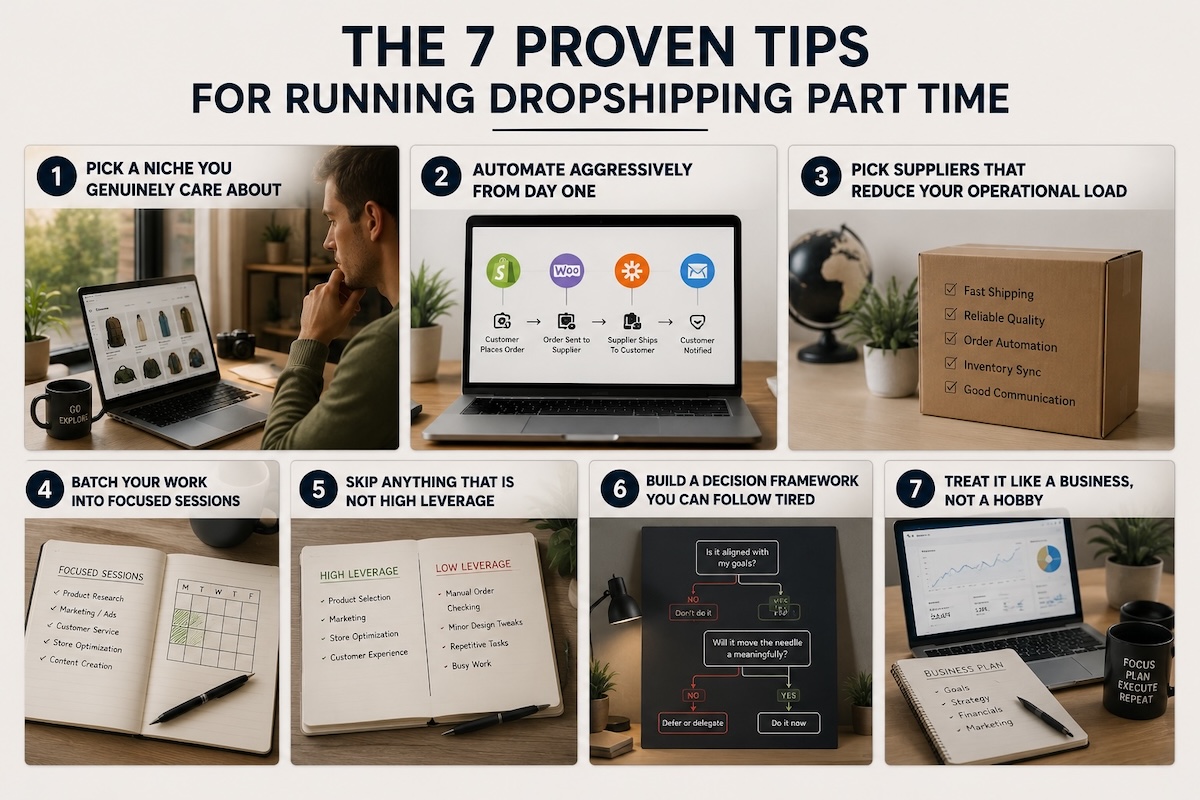
Once your expectations are set correctly, the practical tips become a lot more effective. Here are the seven habits that experienced part time operators use to fit a real store into a real life.
1. Pick A Niche You Genuinely Care About
When time is limited, motivation matters more than it does for full-timers. If you are bored by your niche, you will not sit down to write product descriptions on a Tuesday night after work. Pick something you actually find interesting. The hours feel shorter and the creative work feels easier when the topic genuinely engages you.
This does not mean turning a hobby into a business at any cost. Profitable niches still need to make sense financially. But within the universe of viable categories, lean toward the ones where you would happily spend an hour reading a forum about the products. Energy management is the real bottleneck of dropshipping part time, and curiosity is renewable energy.
2. Automate Aggressively From Day One
Manual order processing, manual customer emails, manual inventory checks. Each one of those tasks adds up to hours per week that you do not have. Set up automation tools the day you launch the store, even if your sales volume does not yet justify the cost. Future you will thank current you.
A solid automation stack covers order routing, shipping notifications, abandoned cart emails, and basic customer service replies. Our walkthrough on how to automate your dropshipping business covers the practical setup. The goal is to build a store where most days require zero touch, so you can use your limited hours on the work that actually grows the business.
3. Pick Suppliers That Make Things Easier
When something goes wrong with an order, you become the front line of customer support. Slow shipping from overseas suppliers means more emails, more chargebacks, more refund requests, and more time spent firefighting. None of those activities grow the store, and all of them eat your limited hours.
Choosing pre-vetted North American suppliers cuts the support load dramatically. DropCommerce focuses on US and Canadian suppliers with 2 to 5 day shipping, which prevents most of the issues that drain part time operators. Real-time inventory syncing prevents overselling, and seamless Shopify and WooCommerce integration keeps the operational side simple. Fewer fires means more time for the strategic work that actually compounds.
4. Batch Your Work Into Focused Sessions
Spreading 10 hours of work across every weeknight in 30-minute chunks is much less productive than concentrating it into two or three deep sessions. Context switching kills part time productivity. Pick two evenings a week and one weekend block, then protect them like you would a meeting.
Use those sessions to focus on one type of work at a time. One night might be ad creative. Another might be product research. The weekend might be analytics review and email writing. Constantly bouncing between tasks burns time on setup and shutdown costs. Batching cuts that waste and produces visibly better output.
5. Skip Anything That Is Not High Leverage
When you have unlimited time, you can do everything. When you have ten hours a week, you have to be ruthless about what gets attention. Endless A/B testing of button colors, redesigning your logo for the third time, chasing TikTok trends that do not match your product, and reading random YouTube videos are all common time sinks for new operators.
Stick to the work that actually moves revenue. That usually means product testing, ad creative, customer experience, and supplier relationships. Anything else is optional. A simple test: if a task does not directly lead to more orders or higher margins, it goes to the bottom of the list. Most part time operators do too much low-leverage work and not enough of the work that actually grows the store.
6. Build A Decision Framework You Can Follow Tired
Most decisions get worse late at night after a long workday. Building simple decision rules in advance protects you from your own tired brain. Examples: kill any ad creative that has not produced a sale after $50. Pause any product without a sale in 14 days. Auto-refund any order delayed past 10 days without questions.
These rules sound boring, but they are the secret weapon of part time operators. They remove the energy cost of decision-making during low-energy weeks. Write your rules down somewhere you can see them. Update them every month or two as you learn what is working. The fewer decisions you have to make in real time, the more sustainable the store becomes.
7. Treat It Like A Business, Not A Hobby
This sounds obvious, but it is the difference between hobby income and real income. Track expenses. Set a monthly budget. Open a separate business bank account. Send yourself a weekly self-report on revenue, ad spend, and key metrics. Even five minutes a week reviewing the numbers will dramatically change how you make decisions.
Hobbies survive on enthusiasm. Businesses survive on systems. Building those systems early is what separates the side hustles that grow into real income from the ones that fizzle out after a slow month. Our roundup of side hustle ideas frames the broader landscape if you want to see how dropshipping compares to other part time options.
Common Part Time Pitfalls To Avoid

Even motivated operators trip over a small set of repeatable mistakes when they try to fit dropshipping into a busy life. Knowing these in advance is the cheapest insurance you can buy.
Trying To Replicate Full-Time Strategies
Most popular dropshipping advice assumes the operator has unlimited time. Daily TikTok content, hourly ad optimization, weekly product launches. None of that is realistic on ten hours a week, and trying to copy it leads to burnout fast. Adapt the playbook to your actual time budget. A store that gets two ad creative tests per month and one product launch per quarter can absolutely be profitable.
Resist the urge to do what big stores do. They have teams. You do not. Build the version of the playbook that fits your reality, then execute that version consistently. Consistency beats intensity for part time operators almost every time.
Underinvesting In Tools
Some new operators try to save every dollar by skipping paid tools. The math usually does not work. A $30 per month app that saves you three hours per week is a great trade for a part time operator. Three hours back in your week is more valuable than $30 saved in expenses, especially in the early months when growth is the priority.
Pick your tool stack carefully, but do not be cheap about it. Time saved through automation buys you the bandwidth to find your next winning product, which is what actually grows the store.
Ignoring The Skills That Compound
Tactics change every six months. Skills compound over years. Learning copywriting, basic analytics, customer psychology, and creative direction will pay you back across every product, ad, and email you ever launch. Those skills also transfer to whatever else you build next, even if this specific store does not work out.
Spend at least one of your weekly hours on skill building. Read a book about persuasion. Take a short course on Meta ads. Study how brands you admire write their emails. Our breakdown of the most important skills for dropshipping lays out the highest-leverage areas to focus on first.
A Realistic Weekly Schedule
Every part time setup looks slightly different, but a common pattern works for most operators. Two weeknights of two hours each, plus a weekend block of four to six hours. That gets you eight to ten focused hours per week, which is enough to run and slowly grow a profitable store if you spend those hours wisely.
A sample structure might look like this. Tuesday night: review yesterday's ad performance, kill underperformers, write copy for next ad test. Thursday night: customer service inbox, supplier check-ins, basic store maintenance. Saturday morning: deeper analytics review, product research, plan the next two weeks of work. Sunday afternoon: launch new ad creatives so they have data by Tuesday. Tweak this template to match your life. The structure matters more than the specific days. Predictable hours train your brain to focus when those hours arrive.
How DropCommerce Fits A Part Time Operator's Workflow

Part time operators have less margin for error than full-timers. Every supplier issue, every shipping delay, and every overselling incident eats hours you do not have. The supplier side of the business is where this matters most. Cheap overseas suppliers might look attractive on paper, but the support overhead they create is rarely worth the savings, especially when your hours are scarce.
DropCommerce is built for store owners who want to compete on customer experience rather than chasing the cheapest possible cost of goods. All suppliers are US or Canadian and ship in 2 to 5 days. The catalog is pre-vetted across home, beauty, pet, and lifestyle niches. No minimum order requirements let you test products without inventory commitments. Real-time inventory syncing prevents the overselling nightmare. Seamless Shopify and WooCommerce integration means the technical setup stays out of your way.
Pair that with a focused niche, automated workflows, and disciplined hours, and you have a setup that genuinely fits a busy life. The difference between a successful part time store and a frustrating one is rarely the product. It is almost always the operational decisions that surround it.
Knowing When To Go Full Time
A common question from part time operators is when to quit the day job. The honest answer is later than most people think. A safe rule of thumb is that the store should be netting at least 1.5 times your current take-home income, consistently, for six months in a row before you make the jump. Anything less leaves you exposed if a single supplier issue or ad platform change tanks revenue temporarily.
The other signal worth watching is whether the store is genuinely time-constrained, meaning you are leaving real money on the table because you cannot give it more hours. If 30 extra hours a week would obviously double the business, that is a strong signal. If you would mostly use the extra time on busy work, the store is not yet ready for full time attention. Stay patient. The version of you that goes full time after 18 months of part time discipline will be far better equipped than the version that quits after 90 days of optimism.
Final Thoughts on Running Dropshipping Part Time
So can you do dropshipping part time and build something real? Yes, with the right expectations and the right setup. The version that actually works is calmer, more automated, and more patient than the version most influencers pitch. You are not going to build a million-dollar empire in three months on ten hours a week. You can absolutely build a few thousand dollars per month of side income that compounds over a year if you stay consistent.
The most important shift is treating constraints as a feature, not a bug. Limited time forces ruthless focus, which most full-time operators never develop. Limited cash forces patience, which protects you from burning out on bad bets. Embrace the constraints. Build systems that respect them. Pick suppliers and tools that reduce your operational load. Then keep showing up week after week. That is the version of dropshipping part time that actually pays off.

.jpg)


